

Types of Seizures
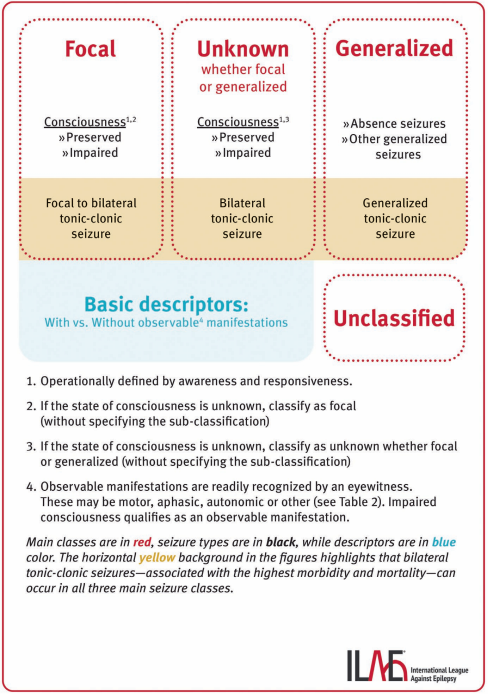
New terms to describe and classify seizures have been developed by the International League Against Epilepsy. This was done to make the names of seizures more accurate, less confusing, and more descriptive of what is happening.
The new terms consider these important areas when describing seizures:
- The onset or beginning of a seizure: Where seizures start in the brain tells a lot about what may occur during a seizure, what other conditions or symptoms may be seen, how they may affect someone and, most importantly, what treatment may be best for that seizure type. When we don’t know if a seizure is focal or generalized in onset, the wrong treatment may be used. Or a person may not be offered a treatment that has the best chance of helping.
- A person’s level of consciousness during a seizure: Whether a person is aware and responsive or not tells a lot about the type of seizure. It’s also very important to know for a person’s safety. We assess awareness by whether the person has the ability to recall what happened during a seizure. We assess responsiveness by whether a person is able to follow a simple command during a seizure.
- Whether there are observable symptoms that happen during a seizure: Seizures can be further described by whether there are noticeable symptoms that occur. These are called "observable manifestations" of the seizure, and can be readily recognized by an eyewitness. This level of description does not need to be used all the time, but can be helpful for certain types of seizures.
Learn More:
Subscribe to Our NewsletterHow Are Seizures Classified Now?
Generalized Seizures
These seizures affect both sides of the brain or groups of cells on both sides of the brain at the same time. The term generalized-onset seizures was used before. Examples of generalized seizure types include absence, or atonic seizures. Tonic clonic seizures can either start out as generalized seizures from the start of the seizure, or can start as a focal seizure that then spreads to the other side of the brain to become a generalized tonic clonic seizure.
Focal Seizures
The term focal is used to be more accurate when talking about where seizures begin. Focal seizures start in one area or group of cells in one side of the brain. This seizure type was previously called focal-onset seizures or partial seizures.
- Focal seizure with preserved consciousness : When a person is awake and aware during a seizure, it’s now called a focal seizure with preserved consciousness. Older names for this seizure type used to be a focal onset aware or simple partial seizure.
- Focal seizure with impaired consciousness: When a person is confused or their awareness is affected in some way during a focal seizure, it’s now called a focal seizure with impaired consciousness. Older names for this type of seizure were focal onset impaired aware or complex partial seizure.
- After it starts, a focal seizure can sometimes spread to both sides of the brain and become a generalized tonic-clonic seizure (this is now known as a focal to bilateral tonic-clonic seizure). People with this seizure type often have an aura before the tonic-clonic seizure begins.
Unknown Seizures
When the beginning of a seizure is not known, it’s now called an unknown whether focal or generalized seizure. A seizure could also be called an unknown onset if it’s not been witnessed or seen by anyone (for example when seizures happen at night or in a person who lives alone).
- As more information is learned and the person's typical seizure is witnessed, an unknown whether focal or generalized seizure may later be diagnosed as a focal or generalized seizure.
What if I Don’t Know What Type of Seizures I or My Loved One Have?
It’s not unusual that a person doesn’t know the type of seizure they have. Often seizures are diagnosed based on descriptions of what an observer has seen. These descriptions may not be fully complete, or one can’t tell where a seizure begins from this information.
When seizures are difficult to diagnose or seizure medicines are not working to stop seizures, talk to your doctor or treating healthcare provider.
- Seeing an epilepsy specialist or having an evaluation at an epilepsy center can help find out if you are having seizures. Not all events are due to epilepsy.
- An epilepsy center help you explore other treatment options, such as surgery, devices, dietary therapy, new or add-on seizure medications, or a clinical trial.
- Having imaging tests like an MRI (magnetic resonance imaging) scan to look at the brain and EEG (electroencephalogram) tests to record the electrical activity of the brain are very helpful to diagnose types of seizures and epilepsy properly.
- Keep asking questions so you get the right tests and right treatment for your type of seizures and epilepsy.
How Can I Learn More?
Take information to your healthcare team along with a description of your seizures. Ask family or friends to write down what they see happening or to take a video. Then ask for help understanding your seizure types.
Learn More:
Donate to Support People Living with EpilepsyResources
Epilepsy Centers
Epilepsy centers provide you with a team of specialists to help you diagnose your epilepsy and explore treatment options.
Epilepsy Medication
Find in-depth information on anti-seizure medications so you know what to ask your doctor.
Epilepsy and Seizures Helpline
Call our Epilepsy and Seizures Helpline and talk with an epilepsy information specialist or submit a question online.
Tools & Resources
Get information, tips, and more to help you manage your epilepsy.
Related Stories



Press Releases
Epilepsy Foundation of America’s National Walk for Epilepsy Set to Return to Washington D.C.
Read Story