
Vagus Nerve Stimulation (VNS) Therapy
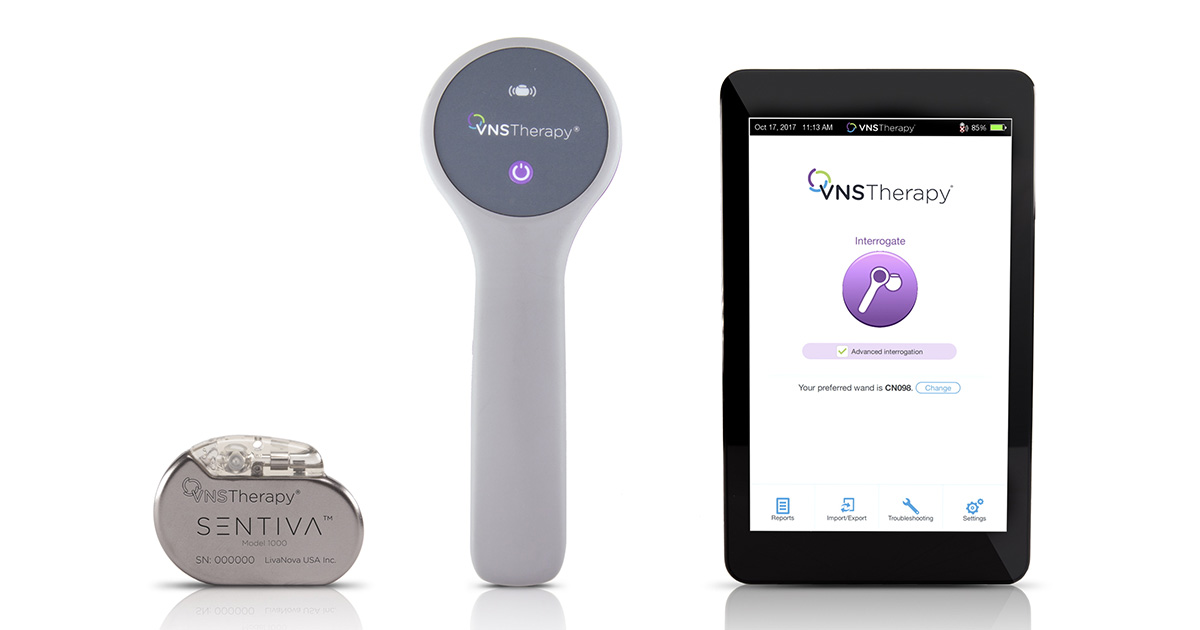
Vagus nerve stimulation (VNS) with SenTivaTM VNS Therapy® by LivaNova
What Is VNS Therapy®?
VNS Therapy® (also called vagus nerve stimulation) has been approved by the U.S. Food and Drug Administration (FDA) as an add-on therapy for adults and children 4 years and older. It is approved to treat focal or partial seizures that do not respond to seizure medications. This is called drug-resistant epilepsy or refractory epilepsy.
- Vagus nerve stimulation (VNS) may prevent or lessen seizures by sending regular, mild pulses of electrical energy to the brain via the vagus nerve.
- The therapy consists of a device that is implanted under the skin in the left chest area. An electrode or wire is attached to the generator device and placed under the skin. The wire is attached or wound around the vagus nerve in the neck.
- The device is programmed in the outpatient clinic to deliver pulses or stimulation at regular intervals. A person does not need to do anything for this device to work.
- A person with a VNS device is usually not aware of the stimulation while it is working.
- If a person is aware of when a seizure happens, they can swipe a magnet over the generator in the left chest area to send an extra burst of stimulation to the brain. For some people this may help stop seizures.
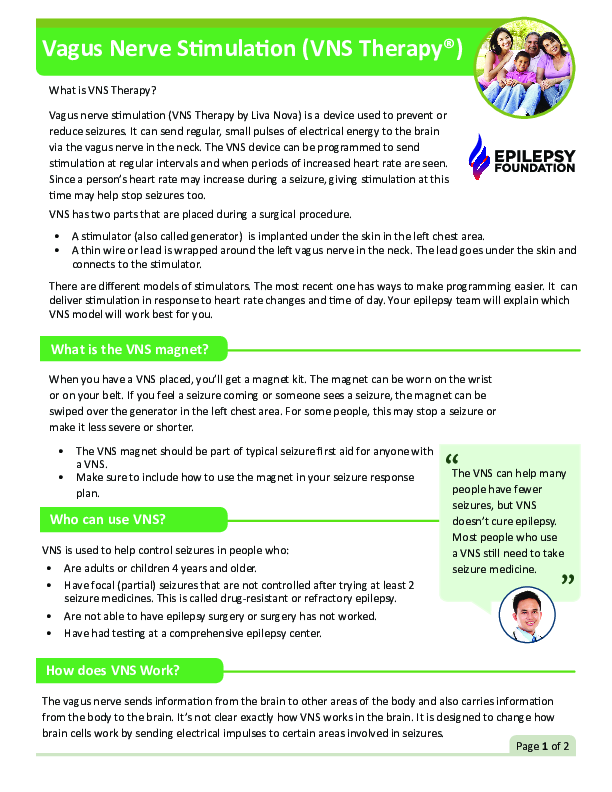
Factsheet
Download this factsheet to learn about VNS, how it works, and who can use it.
How Does It Work?
Vagus nerve stimulation (VNS) is a type of neuromodulation. It is designed to change how brain cells work by giving electrical stimulation to certain areas involved in seizures.
The vagus nerve is part of the autonomic nervous system, which controls functions of the body that are not under voluntary control (such as heart rate and breathing). The vagus nerve sends information from the brain to other areas of the body. It also carries information from the body to the brain.
- We don’t know exactly how VNS works. Research has shown that VNS may help control seizures by:
- Increasing blood flow in key brain areas
- Raising levels of some brain substances (called neurotransmitters) important to control seizures
- Changing EEG (electroencephalogram) patterns during a seizure
- 8 out of 10 people with epilepsy may have an increase in their heart rate before a seizure.
- In the newer VNS models (AspireSR® and SenTivaTM), a fast increase in heart rate can be picked up. This triggers an extra burst of stimulation to help stop these seizures.
- These models may be especially helpful for people who are not aware of when seizures happen, if seizures are not witnessed, or if seizures occur at night.
Learn More:
Donate to Support Our MissionHow Helpful Is Vagus Nerve Stimulation?
This therapy does not cure epilepsy. It’s designed to help control seizures by lessening the number and severity of seizures.
- Initially, people with VNS had an average decrease in seizures by 28% in the first 3 months.
- A review of 65 people who were had VNS for 10 years or more, showed improvements in seizure control over time. Seizures decreased by 36% after 6 months, 58% after 4 years, and 75% by 10 years after the VNS was placed.
- Other ways VNS may help people were reported in a study of 112 adults with focal epilepsy that did not respond to medicines. People were placed in two groups: 1) VNS therapy and best medical practice, or 2) No VNS but received best medical practice. Information was collected over a 1-year period. Results of this study showed:
- Recovery time after a seizure may be shorter for some people.
- 8 of 10 people reported an improved quality of life.
- About 6 of 10 reported less worry about seizures and improved alertness.
- Half the people reported that their seizures were less severe.
When Is Vagus Nerve Stimulation Used?
VNS is used for people with refractory or drug-resistant epilepsy. This means seizures are not controlled after trying at least 2 appropriate seizure medications.
- It’s an add-on treatment, which means it is used in addition to seizure medicines. For some people, when VNS works well, the dose or use of a seizure medicine may be decreased.
- VNS is usually used if a person is not able to have epilepsy surgery or if surgery does not work.
- Sometimes a person may be offered VNS if other reasons make surgery not possible.
How Do I Know If I Am A Candidate For Vagus Nerve Stimulation?
When considering VNS, ideally a person is first seen at a comprehensive epilepsy center to make sure that all options have been explored and that the procedure is right for them.
Here are a few questions that need to be asked.
What type of seizures do you have?
- VNS will not help seizures that are not epileptic and not associated with electrical activity in the brain.
- It’s primarily indicated for focal seizures, but people with some types of generalized seizures, including Lennox Gastaut Syndrome, have improved too.
Is the epilepsy truly drug-resistant and uncontrolled?
- It’s important to see if other factors may be affecting seizures, and to treat those things first. For example, if a person is having trouble taking medications regularly or has other lifestyle factors affecting seizures, counseling and education about trigger management would be needed first.
- An epilepsy specialist would review the types of medicines that you have tried and make sure that you have tried the correct drugs for the right type of seizures. And tried them for a long enough period of time.
Are there other health problems that could be affected by vagus nerve stimulation?
- People with significant asthma or other breathing problems, sleep apnea, or some heart problems may be advised against using vagus nerve stimulation. Sometimes, other medical problems like these could get worse with VNS.
- Anyone considering VNS (or any type of device) should check first with their primary care doctor to make sure this is right for them.
- People with only one vagus nerve would not be good candidates for VNS.
- People who have had abnormal heart rhythms (arrhythmias) or a low heart rate (bradycardia) should not use the autostimulation settings in the newer VNS models.
Can you get to the hospital or clinic for visits to program and follow up on the device?
- Work with your epilepsy team ahead of time to know how often visits will be needed and how long they will be.
- Have a family member or friend go with you to appointments, at least in the beginning. Once you are used to the therapy, you can usually go alone, but make sure you are safe to travel alone.
Do you have support from family and friends? Do you feel emotionally ready to have this procedure?
- Some people may be bothered initially by having a device put in their body, but they get used to it.
- The stimulation can also be adjusted so most people will not feel it.
Are There Different Types Or Models Of Vagus Nerve Stimulation?
Over the years, technology has allowed new features to be added. There are now 3 groups of devices.
Standard Models
These are the earliest devices. These have the basic programming features.
- A variety of settings can be adjusted. Usually stimulation is given for 30 seconds every 5 minutes. Some people do better with different on and off settings.
- A magnet can be used to trigger additional stimulation during a seizure.
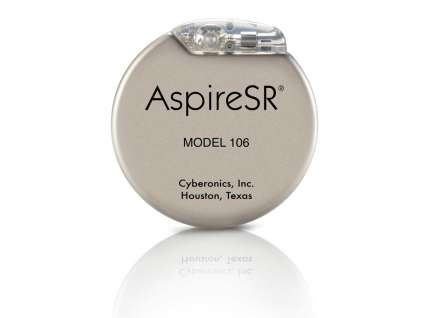
AspireSR® Model
- Studies of this model showed that people who had heart rate increases with seizures could get more help with this autostimulation feature.
- The stimulation will also occur at pre-programmed settings throughout the day and night.
- A magnet can still be used for extra stimulation at the time of a seizure.
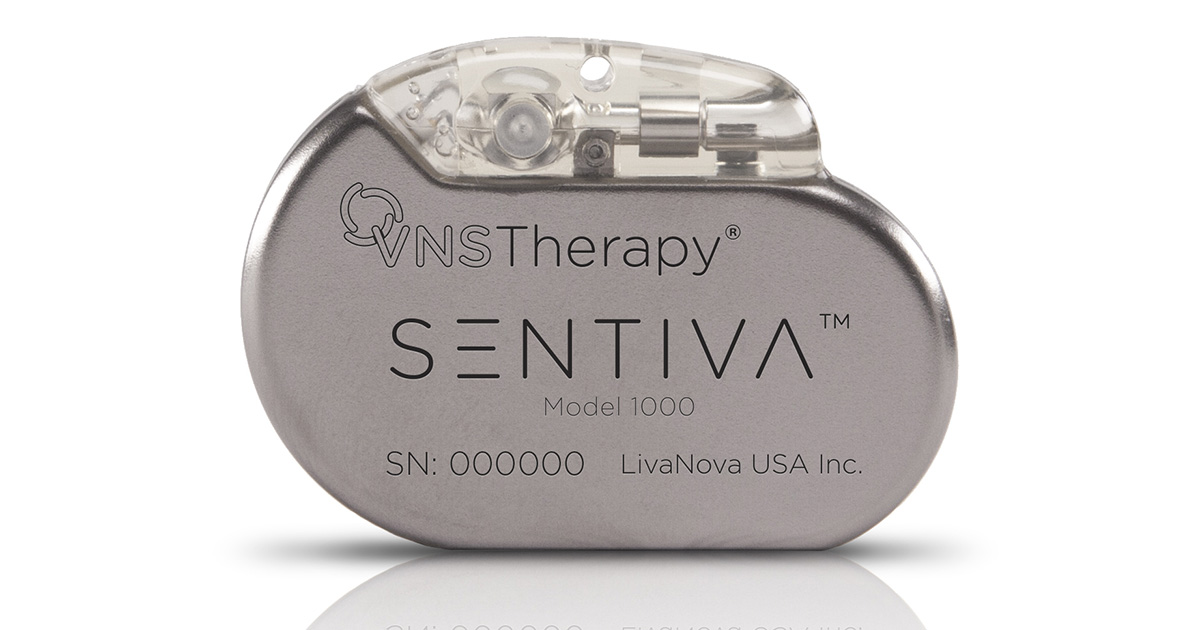
SenTivaTM Model
This is the newest model of vagus nerve stimulation.
- Programmed stimulation can still be done, but now the amount of stimulation can be adjusted at different times of the day. (For example, day and night can have different settings.)
- Autostimulation can be given when the device detects a period of fast heartbeat.
- A magnet can still be used when a person has a seizure.
- Programming can be tailored to each person. For example, the programmer can set stimulation settings to change without coming to the hospital for each visit.
- The device can be set to detect if a person is lying flat after a seizure.
Resources
Find an epilepsy specialist to help you explore this, and other, treatment options.
The VNS Therapy® implant devices are built by LivaNova (formerly Cyberonics, Inc.). Additional information for patients and physicians is available on their website (www.livanova.com/epilepsy-vnstherapy).
Images on this page included with permission from LivaNova.
Learn More:
Contact Our HelplineResources
Epilepsy Centers
Epilepsy centers provide you with a team of specialists to help you diagnose your epilepsy and explore treatment options.
Epilepsy Medication
Find in-depth information on anti-seizure medications so you know what to ask your doctor.
Epilepsy and Seizures Helpline
Call our Epilepsy and Seizures Helpline and talk with an epilepsy information specialist or submit a question online.
Tools & Resources
Get information, tips, and more to help you manage your epilepsy.
Related Stories

Press Releases
Joyce A. Cramer to Receive Lifetime Accelerator Award for Transformative Contributions to Clinical Research and Epilepsy Innovation
Read Story
